fbpx

SIX Network ประกาศความร่วมมือกับ Selanet ผู้โครงสร้างพื้นฐานสำหรับ AI Agents

SIX Network ประกาศความร่วมมือกับ Selanet ผู้โครงสร้างพื้นฐานสำหรับ AI Agents

​​SIX Network Announces Partnership with Selanet, AI Agent Infrastructure Developer, to Drive Web3 Ecosystem Growth

SIX Network ประกาศความร่วมมือกับ Selanet ผู้พัฒนา Infrastructure สำหรับ AI Agents เพื่อขับเคลื่อน Web3 Ecosystem


เรามีความยินดีอย่างยิ่งที่ได้ประกาศความร่วมมือกับ Selanet ผู้พัฒนาโครงสร้างพื้นฐานดิจิทัลที่ช่วยให้ AI agents สามารถทำงานบนเว็บไซต์ต่าง ๆ ได้อัตโนมัติและเชื่อถือได้ในระดับ production โดย Selanet ช่วยให้ AI agents สามารถเข้าถึง ทำความเข้าใจ และดำเนินการบนเว็บไซต์จริงได้ ไม่ว่าจะเป็นการโต้ตอบกับระบบหรือการทำ workflow ต่าง ๆ แบบ end to end


ความร่วมมือครั้งนี้สะท้อนการนำ AI agents เข้ามาเป็นส่วนหนึ่งของโครงสร้างพื้นฐาน เพื่อขับเคลื่อน Web3 ecosystem ในระดับที่ลึกยิ่งขึ้น


จาก Tool สู่ Infrastructure: วิสัยทัศน์ร่วมของ AI และ Blockchain


การร่วมมือกันในครั้งนี้แสดงให้เห็นถึงการนำ AI agents มาทำงานจริงบน infrastructure ระดับ production ซึ่งสอดคล้องกับทิศทางของ SIX Network ที่กำลังศึกษาและพัฒนาแนวทางการผสาน AI เข้ากับ blockchain เพื่อสร้างระบบที่ชาญฉลาดและขับเคลื่อนด้วยข้อมูลมากยิ่งขึ้น


Selanet แสดงให้เห็นถึงแนวทางของการสร้าง execution layer สำหรับ AI agents ที่สามารถเชื่อมต่อเข้ากับระบบดิจิทัลและ ecosystem ของ Web3 ได้ในทางปฏิบัติ


ความร่วมมือครั้งนี้เปิดโอกาสให้ SIX Network สามารถนำแนวคิดของ AI-driven infrastructure มาประยุกต์ใช้ในการออกแบบ ecosystem และพัฒนากลไกต่าง ๆ เช่น การออกแบบ incentive structure การวางกลยุทธ์การเติบโตของ community และการพัฒนาโปรแกรมที่อิงจากพฤติกรรมผู้ใช้งานจริง


SIX Network อยู่ระหว่างการศึกษาแนวทางในการนำ AI agents มาใช้ร่วมกับ ecosystem และ community initiatives ที่กำลังจะเกิดขึ้น


โปรดติดตามในเร็ว ๆ นี้

⎯⎯⎯⎯⎯⎯⎯⎯⎯⎯⎯⎯⎯⎯⎯⎯⎯⎯⎯⎯⎯⎯⎯⎯⎯⎯⎯⎯⎯⎯⎯⎯

Disclaimer:

1.This article is intended for informational purposes only. Please conduct your own research before making any investment decisions related to cryptocurrencies 2. Cryptocurrency and digital token involve high risk; investors may lose all investment money and should study information carefully and make investments according to their own risk profile.


Don’t miss out follow us at:

Warisara Thepsiri
Warisara Thepsiri

Experience the magic of Blockchain with SIX Network!

Related Posts

​​SIX Network Announces Partnership with Selanet, AI Agent Infrastructure Developer, to Drive Web3 Ecosystem Growth

SIX Network ประกาศความร่วมมือกับ Selanet ผู้โครงสร้างพื้นฐานสำหรับ AI Agents

SIX Network ประกาศความร่วมมือกับ Selanet ผู้พัฒนา Infrastructure สำหรับ AI Agents เพื่อขับเคลื่อน Web3 Ecosystem   เรามีความยินดีอย่างยิ่งที่ได้ประกาศความร่วมมือกับ Selanet ผู้พัฒนาโครงสร้างพื้นฐานดิจิทัลที่ช่วยให้ AI agents สามารถทำงานบนเว็บไซต์ต่าง ๆ

Read More

​​SIX Network Announces Partnership with Selanet AI Infrastructure

​​SIX Network Announces Partnership with Selanet AI Infrastructure

​​SIX Network Announces Partnership with Selanet, AI Agent Infrastructure Developer, to Drive Web3 Ecosystem Growth

​​SIX Network Partners with Selanet, AI Agent Infrastructure Developer, to Drive Web3 Ecosystem Growth


We are pleased to announce our collaboration with Selanet, a digital infrastructure developer that enables AI agents to operate autonomously and reliably across websites at a production level. Selanet enables AI agents to access, understand, and execute actions on real-world websites, including interacting with systems and completing end to end workflows.


This partnership reflects the integration of AI agents as part of the infrastructure layer, contributing to the advancement of the Web3 ecosystem at a deeper level.


From Tool to Infrastructure: A Shared Vision of AI and Blockchain


This collaboration demonstrates the real-world deployment of AI agents on production-grade infrastructure, aligning with SIX Network’s direction in exploring and developing the integration of AI with blockchain to build more intelligent, data-driven systems.


Selanet represents an approach to building an execution layer for AI agents that can connect with digital systems and the Web3 ecosystem in practical use cases.


This partnership also creates an opportunity for SIX Network to apply AI-driven infrastructure concepts in ecosystem design and mechanism development, including incentive structures, community growth strategies, and programs based on real user behavior.


What’s Next

SIX Network is currently exploring how AI agents can be integrated into upcoming ecosystem and community initiatives.


Stay tuned.

⎯⎯⎯⎯⎯⎯⎯⎯⎯⎯⎯⎯⎯⎯⎯⎯⎯⎯⎯⎯⎯⎯⎯⎯⎯⎯⎯⎯⎯⎯⎯⎯

Disclaimer:

1.This article is intended for informational purposes only. Please conduct your own research before making any investment decisions related to cryptocurrencies 2. Cryptocurrency and digital token involve high risk; investors may lose all investment money and should study information carefully and make investments according to their own risk profile.


Don’t miss out follow us at:

Warisara Thepsiri
Warisara Thepsiri

Experience the magic of Blockchain with SIX Network!

Related Posts

​​SIX Network Announces Partnership with Selanet, AI Agent Infrastructure Developer, to Drive Web3 Ecosystem Growth

SIX Network ประกาศความร่วมมือกับ Selanet ผู้โครงสร้างพื้นฐานสำหรับ AI Agents

SIX Network ประกาศความร่วมมือกับ Selanet ผู้พัฒนา Infrastructure สำหรับ AI Agents เพื่อขับเคลื่อน Web3 Ecosystem   เรามีความยินดีอย่างยิ่งที่ได้ประกาศความร่วมมือกับ Selanet ผู้พัฒนาโครงสร้างพื้นฐานดิจิทัลที่ช่วยให้ AI agents สามารถทำงานบนเว็บไซต์ต่าง ๆ

Read More

Series Blog 4: Operationalizing Regulatory Architecture

Series Blog 4: Operationalizing Regulatory Architecture

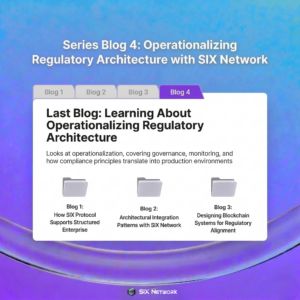
Series Blog 4 Operationalizing Regulatory Architecture with SIX Network

Understanding regulatory principles is only the first step. The more difficult challenge lies in operationalizing those principles within live systems.


Moving from compliance design to production deployment requires coordination between architecture, legal, operations, and security teams.


Embedding Compliance into Operational Workflows


Rather than treating compliance as a reporting function, mature architectures embed regulatory controls into transaction workflows.


Examples include:

• Multi-level approval processes before transaction finalization

• Automated logging of authorization events

• Clearly defined retention and archival policies

• Defined escalation paths for exceptional cases


These controls are implemented primarily in enterprise application logic and governance frameworks. Blockchain serves as a verifiable execution and recording layer.


SIX Garage and related tooling can assist in structuring asset management and permission workflows, but they operate within broader governance systems defined by the organization.


Monitoring and Continuous Oversight


Production systems require observability. Compliance does not end at deployment; it requires continuous oversight.


Architectural monitoring typically covers:

• Transaction latency and failure rates

• Role misuse or unauthorized access attempts

• Data consistency across on-chain and off-chain components

• Audit trail completeness


SIX Network infrastructure can be integrated into existing monitoring frameworks, allowing blockchain operations to be managed alongside other enterprise systems.


From Policy to Implementation


Regulatory frameworks such as GDPR, HIPAA, SOX, or AML/KYC define principles. Implementation varies by jurisdiction and organization.


No protocol can automatically guarantee compliance across all contexts. Instead, infrastructure should provide flexibility and traceability that enable organizations to implement their own compliance interpretations.


SIX Network’s approach emphasizes architectural support rather than automated regulatory guarantees.


Conclusion


Enterprise blockchain deployment in regulated environments requires architectural rigor, governance clarity, and operational discipline.


SIX Network’s standards-based protocol and supporting tools are designed to align with these enterprise requirements, not to replace them.


By approaching integration and compliance as architectural challenges rather than marketing features, organizations can move toward sustainable, production-ready blockchain adoption.

⎯⎯⎯⎯⎯⎯⎯⎯⎯⎯⎯⎯⎯⎯⎯⎯⎯⎯⎯⎯⎯⎯⎯⎯⎯⎯⎯⎯⎯⎯⎯⎯

Disclaimer:

1.This article is intended for informational purposes only. Please conduct your own research before making any investment decisions related to cryptocurrencies 2. Cryptocurrency and digital token involve high risk; investors may lose all investment money and should study information carefully and make investments according to their own risk profile.


Don’t miss out follow us at:

Warisara Thepsiri
Warisara Thepsiri

Experience the magic of Blockchain with SIX Network!

Related Posts

​​SIX Network Announces Partnership with Selanet, AI Agent Infrastructure Developer, to Drive Web3 Ecosystem Growth

SIX Network ประกาศความร่วมมือกับ Selanet ผู้โครงสร้างพื้นฐานสำหรับ AI Agents

SIX Network ประกาศความร่วมมือกับ Selanet ผู้พัฒนา Infrastructure สำหรับ AI Agents เพื่อขับเคลื่อน Web3 Ecosystem   เรามีความยินดีอย่างยิ่งที่ได้ประกาศความร่วมมือกับ Selanet ผู้พัฒนาโครงสร้างพื้นฐานดิจิทัลที่ช่วยให้ AI agents สามารถทำงานบนเว็บไซต์ต่าง ๆ

Read More

Series Blog 3: Designing Blockchain for Regulatory Alignment

Series Blog 3: Designing Blockchain for Regulatory Alignment

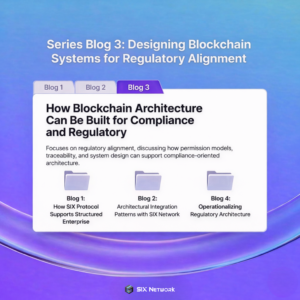
Series Blog 3 Designing Blockchain Systems for Regulatory Alignment

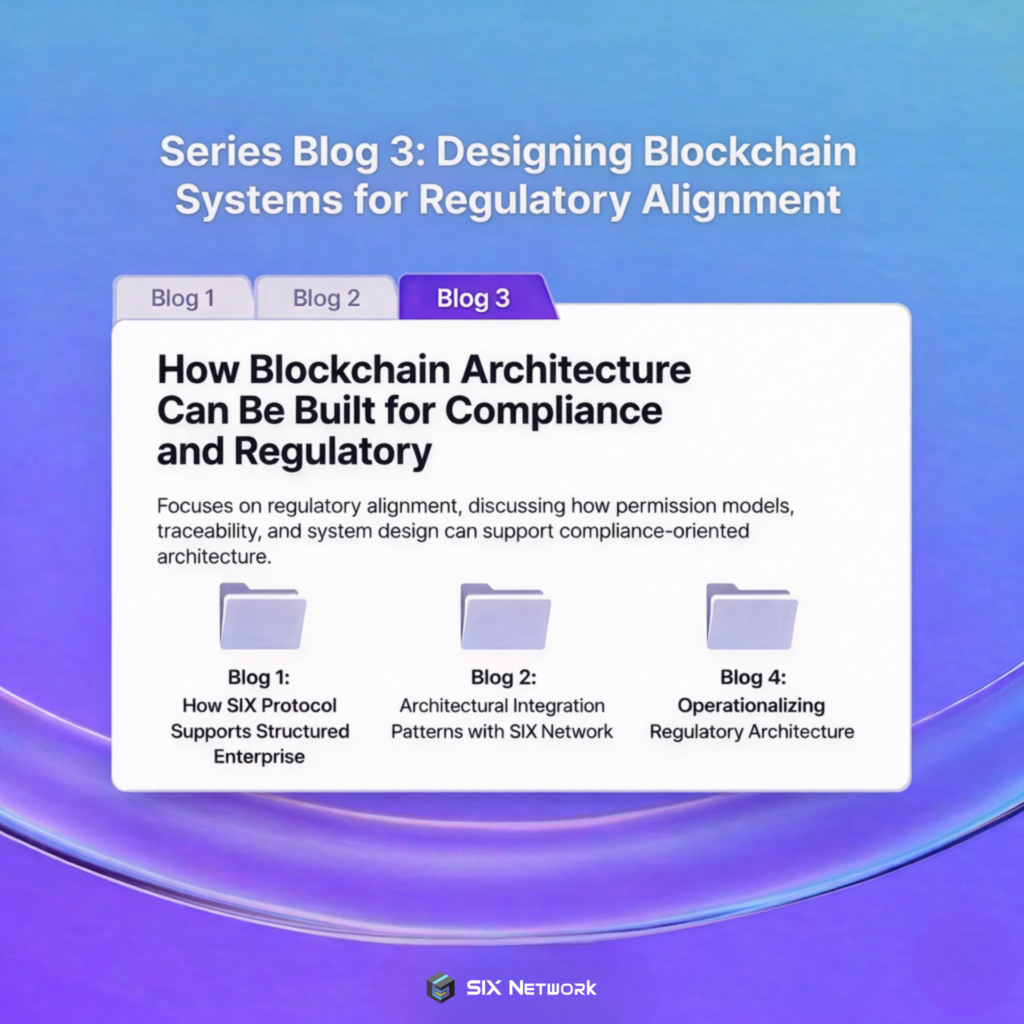
Enter to Blog 3: How Blockchain Architecture Can Be Built for Compliance and Regulatory


Compliance concerns often surface early in blockchain discussions. Questions about immutability, data protection, and auditability frequently delay adoption decisions.


However, many compliance challenges arise not from blockchain itself, but from incomplete architectural design. Regulatory alignment is rarely achieved through features alone. It requires deliberate system partitioning and governance modeling.


This article explores how compliance can be approached as an architectural principle rather than a reactive requirement.


Separation of On-Chain and Off-Chain Data

One of the most common misconceptions is that all operational data must reside on-chain. In regulated environments, this is rarely appropriate.


A structured architecture typically separates:

• Transaction proofs and hashes (on-chain)

• Sensitive or personal data (off-chain, within controlled databases)


Blockchain functions as an integrity and verification layer rather than a primary data repository.


SIX Protocol can support this model because it does not impose a rigid data storage architecture. Organizations retain flexibility in determining what information is recorded on-chain.


Permissioned Control and Identity Mapping


Regulatory frameworks often require clear attribution of actions. This means system architecture must map enterprise identity management systems to blockchain-level roles.


Permissioned models allow organizations to define who can initiate, approve, or view specific transactions. However, identity verification and access governance remain enterprise responsibilities.


SIX Protocol’s permission structures and traceable transaction metadata can support this alignment, but compliance ultimately depends on governance processes and audit design.


Auditability Without Overexposure


Another common concern involves transparency. Public blockchains expose transaction data broadly, which may conflict with confidentiality requirements.


Architectural strategies such as encryption, role-based access control, and metadata minimization allow organizations to maintain auditability without disclosing unnecessary information.


The objective is controlled transparency, providing regulators and auditors with verifiable records while limiting exposure of sensitive business data.


Complete Your Design Blockchain Systems 


Compliance should not be treated as a secondary checklist applied after system deployment. It must inform architectural decisions from the beginning.


SIX Protocol provides technical capabilities, permission models, traceability, and integration flexibility that can support compliance-oriented design. However, regulatory alignment is achieved through thoughtful system architecture and operational governance.


In the final article, we explore practical considerations for moving from compliance design principles to operational deployment.


────────────────────────────────────


Learn more about SIX Network

Website l Telegram l Twitter l Facebook l Discord l Medium

⎯⎯⎯⎯⎯⎯⎯⎯⎯⎯⎯⎯⎯⎯⎯⎯⎯⎯⎯⎯⎯⎯⎯⎯⎯⎯⎯⎯⎯⎯⎯⎯

Disclaimer:

1.This article is intended for informational purposes only. Please conduct your own research before making any investment decisions related to cryptocurrencies 2. Cryptocurrency and digital token involve high risk; investors may lose all investment money and should study information carefully and make investments according to their own risk profile.


Don’t miss out follow us at:

Warisara Thepsiri
Warisara Thepsiri

Experience the magic of Blockchain with SIX Network!

Related Posts

​​SIX Network Announces Partnership with Selanet, AI Agent Infrastructure Developer, to Drive Web3 Ecosystem Growth

SIX Network ประกาศความร่วมมือกับ Selanet ผู้โครงสร้างพื้นฐานสำหรับ AI Agents

SIX Network ประกาศความร่วมมือกับ Selanet ผู้พัฒนา Infrastructure สำหรับ AI Agents เพื่อขับเคลื่อน Web3 Ecosystem   เรามีความยินดีอย่างยิ่งที่ได้ประกาศความร่วมมือกับ Selanet ผู้พัฒนาโครงสร้างพื้นฐานดิจิทัลที่ช่วยให้ AI agents สามารถทำงานบนเว็บไซต์ต่าง ๆ

Read More

Series Blog 2: Architectural Integration Patterns with SIX Network

Series Blog 2: Architectural Integration Patterns with SIX Network

Series Blog2: Architectural Integration Patterns with SIX Network

Enter to Blog 2: Architectural Integration Patterns with SIX Network


In the previous article, we discussed how standards alignment, particularly EVM compatibility, reduces friction during enterprise blockchain adoption. However, compatibility alone does not solve integration complexity. What determines long-term success is architectural discipline.


Enterprise blockchain integration should not be treated as a feature implementation. It is an architectural extension of the existing system landscape. Without clear boundaries and integration patterns, blockchain components risk becoming tightly coupled to core systems, increasing operational risk and long-term maintenance cost.


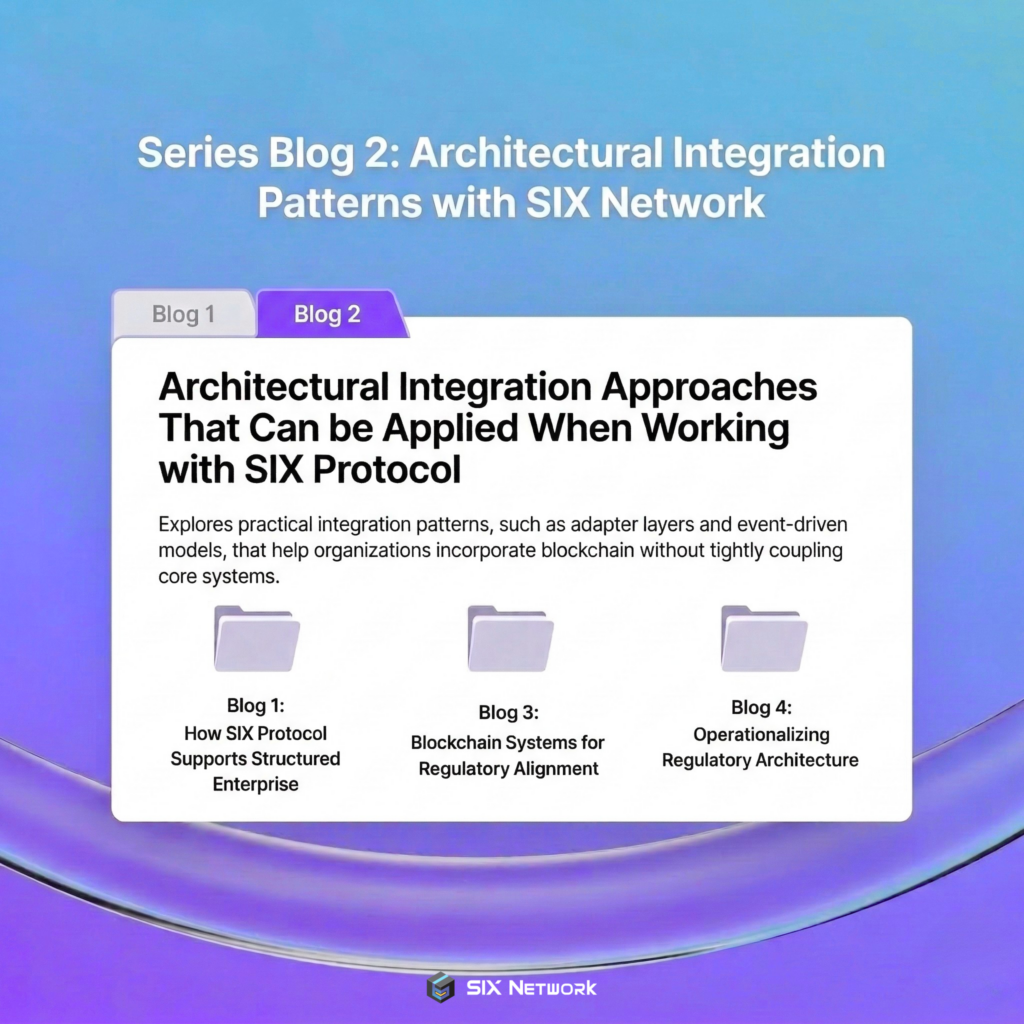
This article examines architectural integration approaches that can be applied when working with SIX Protocol.


The Adapter Layer as an Architectural Boundary


One of the most reliable integration strategies in enterprise environments is the introduction of an adapter or middleware layer between core systems and blockchain infrastructure.


Instead of allowing ERP or CRM systems to directly interact with smart contracts, a controlled integration layer handles:

• Data transformation

• Transaction creation

• Signing and authorization

• Error handling and retry logic


This separation ensures that blockchain-specific concerns remain isolated. Core enterprise systems continue operating using their existing data models and workflows.

SIX Protocol’s standards-based execution environment allows this boundary to be implemented without proprietary constraints. Because it follows EVM standards, integration layers can leverage widely available libraries and established development patterns.


The objective is not simplification through abstraction alone, but architectural containment. Blockchain logic becomes a replaceable or evolvable component rather than a deeply embedded dependency.


Event-Driven Recording Without System Disruption


Many enterprise systems already rely on event-driven architectures. In such environments, blockchain should function as a recording or verification layer triggered by specific business events, rather than as the primary transaction processor.


For example, when an order is finalized or a compliance approval is completed, an event can be emitted internally. A blockchain integration service listens to these events and records relevant transaction metadata onchain.


This approach provides traceability without requiring the core business system to be redesigned. It also reduces operational risk, as business continuity does not depend on blockchain availability.


SIX Protocol supports this model because it does not require tightly coupled execution patterns. It can function as an external integrity layer that complements existing workflows.


Designing for Governance and Observability


Enterprise architects must consider governance and monitoring from the beginning. Blockchain components should integrate into existing operational monitoring frameworks rather than exist as isolated infrastructure.


Key architectural considerations typically include:

• How transaction states are monitored

• How failures are surfaced to operations teams

• How audit logs are correlated across systems

• How identity and permission models map between enterprise systems and blockchain roles


SIX Protocol’s permission capabilities and transaction traceability can support governance design, but they do not replace it. Governance remains an architectural responsibility.


Key Takeaway

Successful blockchain integration is less about adding distributed infrastructure and more about disciplined system design. Adapter layers, event-driven recording, and governance mapping are architectural tools, not product features.


SIX Network’s design choices allow these architectural strategies to be applied without introducing proprietary execution models or isolated tooling stacks.


In the next article, we shift focus from integration patterns to regulatory architecture and compliance-oriented design.


────────────────────────────────────

Learn more about SIX Network

Website l Telegram l Twitter l Facebook l Discord l Medium

⎯⎯⎯⎯⎯⎯⎯⎯⎯⎯⎯⎯⎯⎯⎯⎯⎯⎯⎯⎯⎯⎯⎯⎯⎯⎯⎯⎯⎯⎯⎯⎯

Disclaimer:

1.This article is intended for informational purposes only. Please conduct your own research before making any investment decisions related to cryptocurrencies 2. Cryptocurrency and digital token involve high risk; investors may lose all investment money and should study information carefully and make investments according to their own risk profile.


Don’t miss out follow us at:

Warisara Thepsiri
Warisara Thepsiri

Experience the magic of Blockchain with SIX Network!

Related Posts

​​SIX Network Announces Partnership with Selanet, AI Agent Infrastructure Developer, to Drive Web3 Ecosystem Growth

SIX Network ประกาศความร่วมมือกับ Selanet ผู้โครงสร้างพื้นฐานสำหรับ AI Agents

SIX Network ประกาศความร่วมมือกับ Selanet ผู้พัฒนา Infrastructure สำหรับ AI Agents เพื่อขับเคลื่อน Web3 Ecosystem   เรามีความยินดีอย่างยิ่งที่ได้ประกาศความร่วมมือกับ Selanet ผู้พัฒนาโครงสร้างพื้นฐานดิจิทัลที่ช่วยให้ AI agents สามารถทำงานบนเว็บไซต์ต่าง ๆ

Read More

Introduce Series: How SIX Network Approaches Enterprise Integration and Compliance

Introduce Series: How SIX Network Approaches Enterprise Integration and Compliance

Introduce Series: How SIX Network Approaches Enterprise Integration and Compliance Blog 1

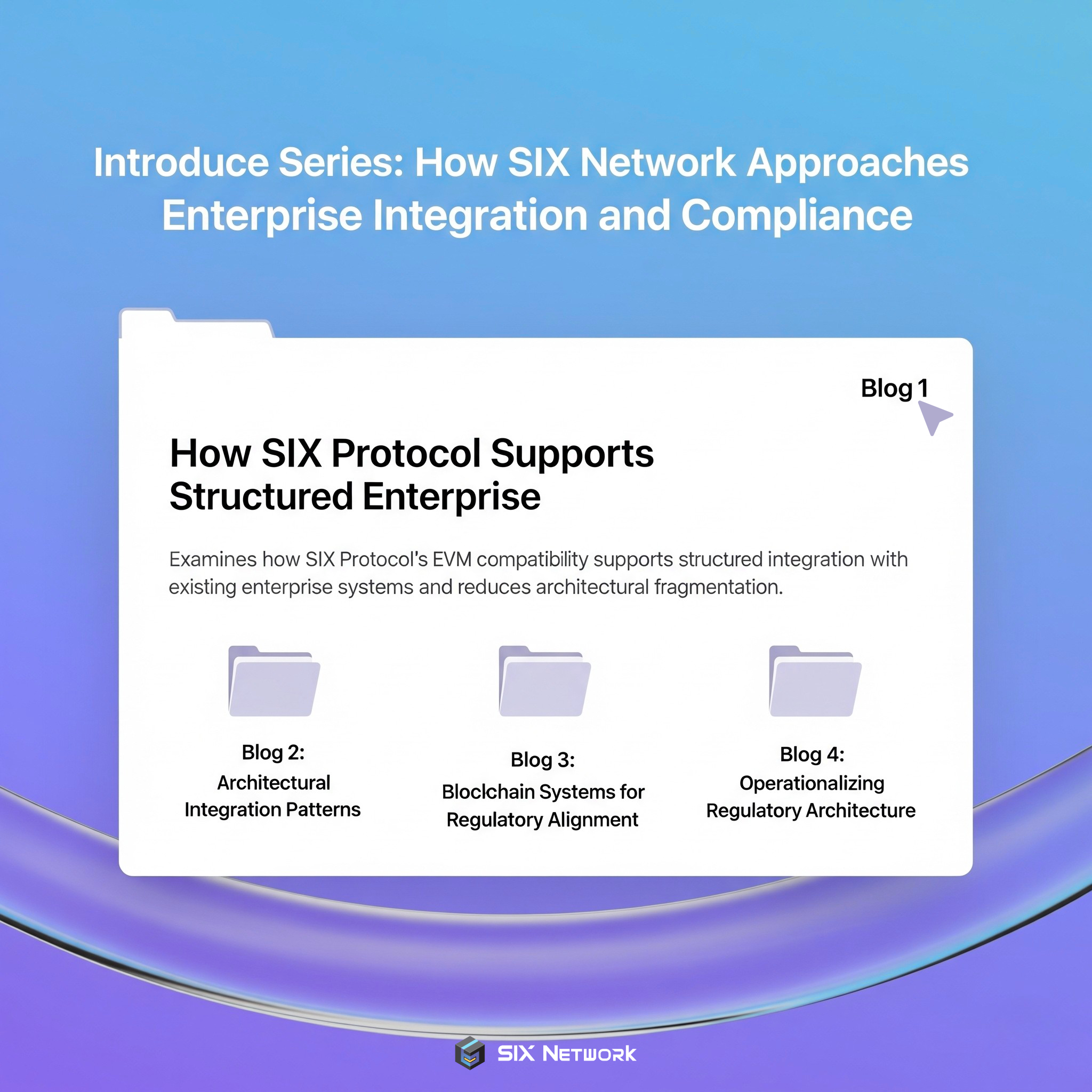
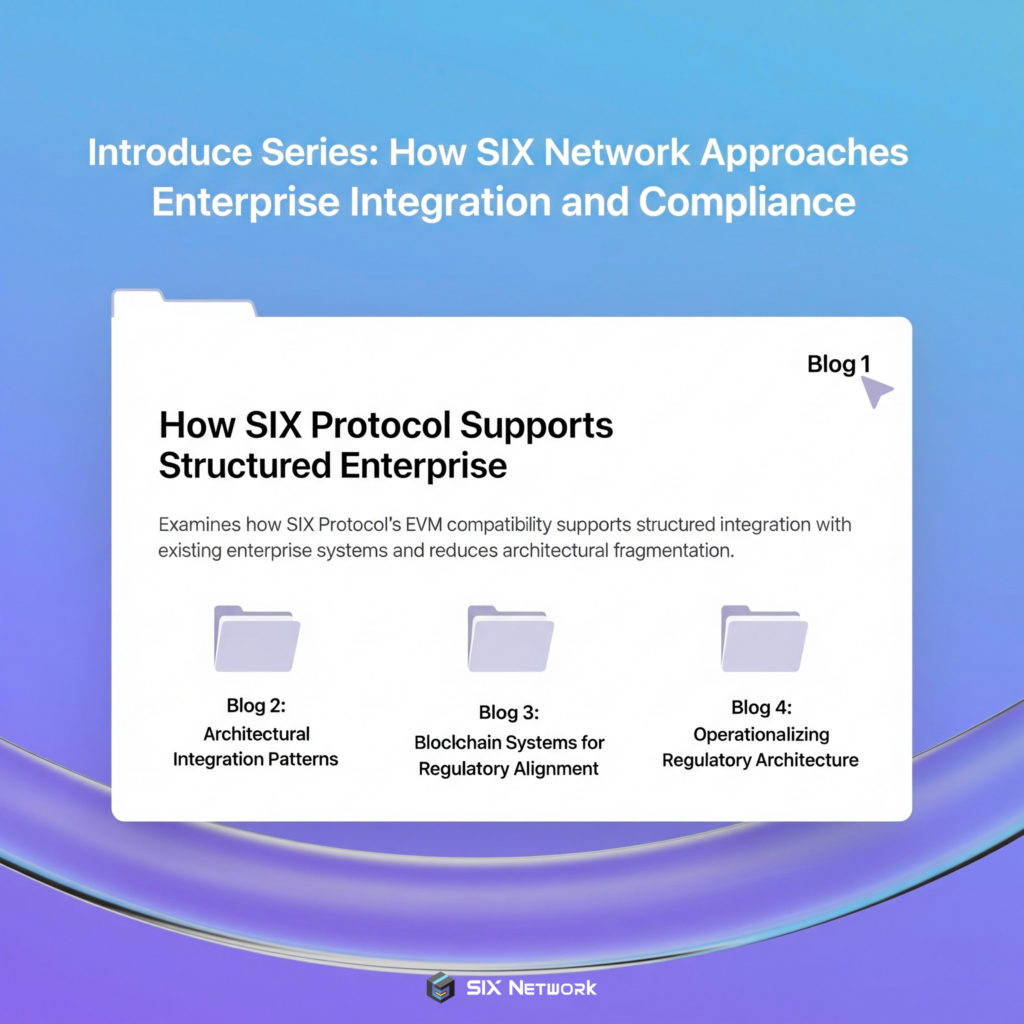
Enterprise blockchain adoption often slows down not because of the technology itself, but because of integration complexity and regulatory considerations. This four-part blog series explores how SIX Network approaches these challenges from an architectural perspective.


Blog 1 examines how SIX Protocol’s EVM compatibility supports structured integration with existing enterprise systems and reduces architectural fragmentation.

Blog 2 explores practical integration patterns, such as adapter layers and event-driven models, that help organizations incorporate blockchain without tightly coupling core systems.

Blog 3 focuses on regulatory alignment, discussing how permission models, traceability, and system design can support compliance-oriented architecture.

Blog 4 looks at operationalization, covering governance, monitoring, and how compliance principles translate into production environments.


Throughout this series, we focus on architectural alignment, governance clarity, and standards-based design as foundations for sustainable enterprise blockchain adoption.


Blog 1

Overcoming Integration Complexity
Part 1: How SIX Protocol Supports Structured Enterprise Blockchain Integration

Enterprise blockchain integration is often perceived as complex and high-risk. In practice, the challenge rarely lies in blockchain technology alone. Instead, complexity arises from how blockchain systems interact with existing enterprise infrastructure, ERP platforms, CRM systems, identity frameworks, data governance models, and regulatory controls.


Many organizations successfully build proof-of-concept projects, but transitioning from pilot to production introduces architectural, operational, and compliance considerations that require structured planning.


SIX Protocol v4.0 was developed with these realities in mind. Rather than introducing a proprietary execution model, SIX Protocol aligns with established industry standards, particularly EVM compatibility. This architectural decision supports integration planning that is more predictable and aligned with existing development ecosystems.


This article is the first in a four-part series exploring how SIX Network approaches integration complexity and regulatory requirements in enterprise environments.


The Practical Role of EVM Compatibility

A common friction point in enterprise adoption is the introduction of new programming languages, tooling stacks, or execution environments. When platforms require proprietary development models, organizations must retrain teams or recruit new talent.


SIX Protocol supports the Ethereum Virtual Machine (EVM) at the core protocol level. Developers can write smart contracts in Solidity and use established development tools such as Hardhat and Truffle. This does not automatically shorten project timelines, but it reduces uncertainty by leveraging a mature ecosystem.


By aligning with widely adopted standards, organizations can reuse existing internal knowledge and external expertise. The decision to support EVM is therefore less about performance marketing and more about minimizing architectural fragmentation.


Supporting Enterprise Workflows Through the SIX Ecosystem

Beyond the protocol layer, SIX Network provides tools that support digital asset implementation.


SIX Garage offers capabilities for issuing and managing digital assets, including token configuration, permission management, and administrative oversight. These functions are designed to assist organizations that require structured governance over digital asset lifecycles.


Pas.ss provides a framework for managing digital privileges and engagement use cases. It integrates with non-custodial wallet models, allowing organizations to implement user-facing digital programs without requiring centralized custody structures.


These tools are not substitutes for enterprise system design. Rather, they serve as building blocks that organizations can integrate into broader digital strategies.


Integration as an Architectural Exercise

Effective enterprise blockchain integration requires separation of concerns. Business logic should remain independent from blockchain execution logic wherever possible. Middleware layers or API gateways can mediate communication between core enterprise systems and blockchain components.


SIX Protocol’s standards-based architecture allows such layering without requiring proprietary infrastructure dependencies. This enables organizations to define clear boundaries between existing systems and blockchain components.


Integration planning should typically include:

• Data flow analysis

• Identity and access control mapping

• Transaction approval workflows

• Monitoring and operational oversight

• Pre-production validation


SIX Network’s design approach supports these structured planning processes rather than replacing them.


Summary

Enterprise blockchain adoption becomes manageable when architectural alignment, governance considerations, and ecosystem compatibility are addressed early.


SIX Protocol’s EVM compatibility and the broader SIX ecosystem are designed to support structured integration planning rather than shortcut it. By relying on established standards and modular tooling, organizations can reduce integration uncertainty and build toward sustainable deployment models.


In the next article, we will examine practical integration patterns that can be applied within enterprise environments using SIX Network infrastructure.

────────────────────────────────────

Learn more about SIX Network

Website l Telegram l Twitter l Facebook l Discord l Medium

⎯⎯⎯⎯⎯⎯⎯⎯⎯⎯⎯⎯⎯⎯⎯⎯⎯⎯⎯⎯⎯⎯⎯⎯⎯⎯⎯⎯⎯⎯⎯⎯

Disclaimer:

1.This article is intended for informational purposes only. Please conduct your own research before making any investment decisions related to cryptocurrencies 2. Cryptocurrency and digital token involve high risk; investors may lose all investment money and should study information carefully and make investments according to their own risk profile.


Don’t miss out follow us at:

Warisara Thepsiri
Warisara Thepsiri

Experience the magic of Blockchain with SIX Network!

Related Posts

​​SIX Network Announces Partnership with Selanet, AI Agent Infrastructure Developer, to Drive Web3 Ecosystem Growth

SIX Network ประกาศความร่วมมือกับ Selanet ผู้โครงสร้างพื้นฐานสำหรับ AI Agents

SIX Network ประกาศความร่วมมือกับ Selanet ผู้พัฒนา Infrastructure สำหรับ AI Agents เพื่อขับเคลื่อน Web3 Ecosystem   เรามีความยินดีอย่างยิ่งที่ได้ประกาศความร่วมมือกับ Selanet ผู้พัฒนาโครงสร้างพื้นฐานดิจิทัลที่ช่วยให้ AI agents สามารถทำงานบนเว็บไซต์ต่าง ๆ

Read More

SIX Protocol Enterprise-Grade Infrastructure

SIX Protocol Enterprise-Grade Infrastructure

SIX Protocol Enterprise-Grade Infrastructure

Understanding Enterprise-Grade Infrastructure for Tokenized Assets with SIX Protocol v4.0

The market for digital assets backed by real-world value continues to expand across sectors such as government bonds, real estate, and commodities. However, market growth does not automatically translate into enterprise readiness.


For organizations, the key question is not what blockchain can do in theory, but what kind of infrastructure is appropriate for mission-critical systems, especially when security, regulatory oversight, and operational stability are involved.


🔎📖  This article explores what enterprise-grade infrastructure means in the context of tokenized assets and how SIX Protocol v4.0 is designed to support these requirements from an architectural perspective.


The Enterprise Challenge

Blockchains designed primarily for general-purpose or public experimentation may not be sufficient for high-value, regulated asset environments.


Real estate tokenization may require structured ownership models, access controls, and traceable approvals across jurisdictions. Commodity trading systems often demand transaction finality within predictable timeframes. Digital securities require auditability, investor protection mechanisms, and alignment with reporting standards.


If the underlying infrastructure cannot support these design considerations, organizations may encounter delayed settlement, unclear access control boundaries, or limited audit transparency. Over time, these constraints affect institutional confidence and long-term scalability.


Enterprise-grade infrastructure must therefore prioritize stability, governance capability, and architectural clarity, not performance alone.


SIX Protocol v4.0 in the Enterprise Context
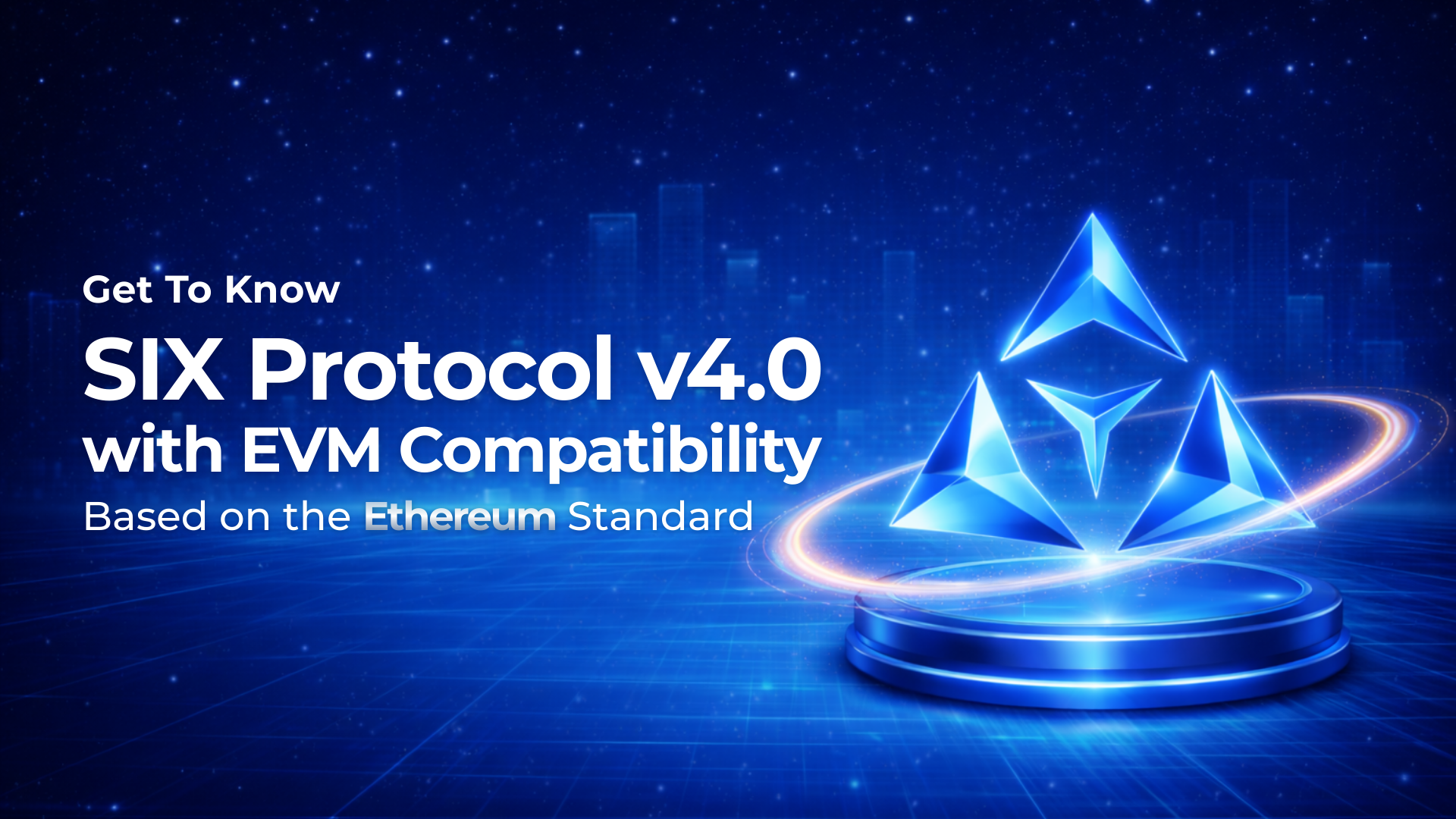
Get to Know SIX Protocol v4.0 with EVM Compatibility Based on the Ethereum Standard For Long-Term Business Development and Blockchain Expansion


SIX Protocol v4.0 was developed with enterprise tokenized asset environments in mind, particularly where real-world asset representation intersects with regulatory and operational requirements.


At the architectural level, the protocol supports EVM compatibility. This allows development teams to leverage established Ethereum tooling and standards, reducing dependency on proprietary execution environments. The intent is not simply familiarity, but architectural alignment with a widely adopted ecosystem.


The protocol operates using a Proof of Authority-based validator model, where validator nodes are managed within a structured network. This model supports predictable transaction validation and controlled governance, characteristics often required in institutional environments.


Rather than maximizing decentralization at all costs, the design balances performance, accountability, and operational reliability.


🔗 Learn more about SIX Protocol v4.0 
SIX Protocol v4.0 EVM Compatibility Based on the Ethereum Standard


Architecture Designed for Scalable Operations

SIX Protocol v4.0 uses a validator network operated under defined governance structures. This configuration reduces operational uncertainty and enables service-level considerations more aligned with enterprise expectations.


Transactions are grouped, validated, and finalized within short timeframes. For organizations handling asset transfers or financial workflows, reduced settlement latency contributes to improved capital efficiency and operational predictability.


The protocol also supports transaction traceability and structured data recording. Sensitive business or personal data does not need to reside fully on-chain. Instead, organizations can implement hybrid architectures where blockchain functions as an integrity and verification layer.


This architectural flexibility allows enterprises to design systems that align with data protection and internal governance policies.


Performance and Scalability

SIX Protocol is capable of processing transactions at a scale suitable for enterprise-level workloads under controlled network conditions. Transaction finality occurs within short intervals, supporting applications that require operational responsiveness.


Performance characteristics are influenced by network configuration and validator distribution, but the protocol is structured to support growing transaction volumes as enterprise adoption expands.


Fee structures are designed to remain stable and predictable relative to many public networks. For organizations managing large transaction volumes, cost predictability can be as important as raw throughput.


Security and Regulatory Alignment

At the application layer, SIX Protocol supports role-based access control, multi-signature authorization, and configurable transaction workflows. These capabilities allow organizations to embed internal approval processes directly into smart contract logic.

The protocol can integrate with external identity verification systems and supports transaction traceability required for compliance-oriented system design. In certain implementations, controlled transaction reversibility mechanisms can be configured to address specific legal or operational requirements.

However, regulatory compliance ultimately depends on organizational governance, policy design, and operational processes. Infrastructure can enable compliance-oriented architecture, but it does not replace regulatory responsibility.


Real-World Deployment Context

SIX Protocol has been used in digital real estate asset issuance scenarios requiring structured ownership and permission management.

In healthcare-related contexts, blockchain has functioned as a verification layer while sensitive patient data remains stored within secure internal systems. This hybrid model reflects a broader enterprise pattern: blockchain complements, rather than replaces, core systems.

These examples illustrate practical deployment models rather than theoretical capabilities.


Ongoing Development Direction

SIX Network continues to evolve its protocol with attention to privacy enhancements, cross-network interoperability, and scalability improvements.


Future development initiatives focus on strengthening architectural flexibility while maintaining governance clarity. Technologies such as advanced privacy techniques and network optimization mechanisms are under evaluation to support long-term enterprise use cases.


Conclusion

Enterprise-grade infrastructure for tokenized assets requires more than transaction speed. It must support governance structures, controlled access, traceability, and sustainable operational design.


SIX Protocol v4.0 reflects these considerations through standards alignment, a structured validator model, and supporting tools such as SIX Garage and Pas.ss that assist in digital asset lifecycle management.


For organizations evaluating blockchain infrastructure, architectural alignment, governance compatibility, and operational stability should weigh more heavily than performance claims alone.


SIX Network’s approach centers on supporting structured, responsible enterprise adoption rather than positioning blockchain as a standalone solution.

────────────────────────────────────

Learn more about SIX Network

Website l Telegram l Twitter l Facebook l Discord l Medium
⎯⎯⎯⎯⎯⎯⎯⎯⎯⎯⎯⎯⎯⎯⎯⎯⎯⎯⎯⎯⎯⎯⎯⎯⎯⎯⎯⎯⎯⎯⎯⎯

Disclaimer:

1.This article is intended for informational purposes only. Please conduct your own research before making any investment decisions related to cryptocurrencies 2. Cryptocurrency and digital token involve high risk; investors may lose all investment money and should study information carefully and make investments according to their own risk profile.


Don’t miss out follow us at:

Warisara Thepsiri
Warisara Thepsiri

Experience the magic of Blockchain with SIX Network!

Related Posts

​​SIX Network Announces Partnership with Selanet, AI Agent Infrastructure Developer, to Drive Web3 Ecosystem Growth

SIX Network ประกาศความร่วมมือกับ Selanet ผู้โครงสร้างพื้นฐานสำหรับ AI Agents

SIX Network ประกาศความร่วมมือกับ Selanet ผู้พัฒนา Infrastructure สำหรับ AI Agents เพื่อขับเคลื่อน Web3 Ecosystem   เรามีความยินดีอย่างยิ่งที่ได้ประกาศความร่วมมือกับ Selanet ผู้พัฒนาโครงสร้างพื้นฐานดิจิทัลที่ช่วยให้ AI agents สามารถทำงานบนเว็บไซต์ต่าง ๆ

Read More

SIX Protocol v4.0 EVM Compatibility Based on the Ethereum Standard

SIX Protocol v4.0 EVM Compatibility Based on the Ethereum Standard

Get to Know SIX Protocol v4.0 with EVM Compatibility Based on the Ethereum Standard For Long-Term Business Development and Blockchain Expansion

For Long Term Business Development and Blockchain Expansion

Many businesses are beginning to view blockchain as a foundational infrastructure for the future. This includes digital assets, payment systems, token issuance, and data management that requires transparency.


The key question is which network an organization should choose to support long term growth and connect smoothly with existing systems.


SIX Protocol v4.0 is developed with Full Native EVM Compatibility. This allows organizations to adapt their existing systems, teams, and expertise to blockchain more easily, while supporting business level scalability.


🔎📖 What EVM is and why supporting this standard matters for enterprises 

EVM, or Ethereum Virtual Machine, is the execution standard for Smart Contracts on the Ethereum network, which serves as a major foundation of today’s Web3 ecosystem. Many developers use Solidity and tools such as MetaMask to build blockchain applications.


When a network supports EVM Compatibility, organizations can use the same development tools and approaches as Ethereum without rebuilding everything from scratch.


For businesses, this directly impacts development time, cost, and risk. When infrastructure aligns with a widely accepted standard, implementation becomes more stable and sustainable.


In recent years, many networks have announced EVM support, but the level of completeness and stability varies. SIX Protocol v4.0 is designed to support EVM fully at the core architectural level.


Business Benefits

– Reduced development time
– Ability to leverage existing teams and expertise
– Scalability for future expansion
– Connectivity with the Ethereum ecosystem

Overview of SIX Protocol v4.0:

EVM Compatibility: Full Native support
Transaction Speed: More than 1000+ TPS
Development Tools: Full ecosystem compatibility
Enterprise Support: Dedicated team support


Guidelines for Success

Businesses planning to adopt blockchain should design their structure from the beginning to ensure stability and long term continuity.

Key considerations include:

– Smart Contract security
– Capacity to support a large number of users
– Data management and access control
– System testing before full deployment


Real-World Use Cases

Example 1: Enterprise Asset Tokenization

A real estate company plans to issue tokens representing ownership rights in assets. The system must support a large number of investors and integrate with standard wallets.


SIX Protocol v4.0 supports existing Smart Contract standards and can handle enterprise level transaction volumes with stability.


Example 2: Payment Infrastructure for Digital Businesses

A fintech company aims to build a blockchain based settlement system capable of handling high transaction volumes with sufficient speed for real-world usage.


SIX Protocol supports high throughput and integrates with existing development tools, enabling practical deployment at the business level.


────────────────────────────────────

Learn more about SIX Protocol v4.0

Elevate your digital infrastructure with blockchain aligned with the Ethereum standard.


Website l Telegram l Twitter l Facebook l Discord l Medium
⎯⎯⎯⎯⎯⎯⎯⎯⎯⎯⎯⎯⎯⎯⎯⎯⎯⎯⎯⎯⎯⎯⎯⎯⎯⎯⎯⎯⎯⎯⎯⎯

Disclaimer:

1.This article is intended for informational purposes only. Please conduct your own research before making any investment decisions related to cryptocurrencies 2. Cryptocurrency and digital token involve high risk; investors may lose all investment money and should study information carefully and make investments according to their own risk profile.


Don’t miss out follow us at:

Warisara Thepsiri
Warisara Thepsiri

Experience the magic of Blockchain with SIX Network!

Related Posts

​​SIX Network Announces Partnership with Selanet, AI Agent Infrastructure Developer, to Drive Web3 Ecosystem Growth

SIX Network ประกาศความร่วมมือกับ Selanet ผู้โครงสร้างพื้นฐานสำหรับ AI Agents

SIX Network ประกาศความร่วมมือกับ Selanet ผู้พัฒนา Infrastructure สำหรับ AI Agents เพื่อขับเคลื่อน Web3 Ecosystem   เรามีความยินดีอย่างยิ่งที่ได้ประกาศความร่วมมือกับ Selanet ผู้พัฒนาโครงสร้างพื้นฐานดิจิทัลที่ช่วยให้ AI agents สามารถทำงานบนเว็บไซต์ต่าง ๆ

Read More

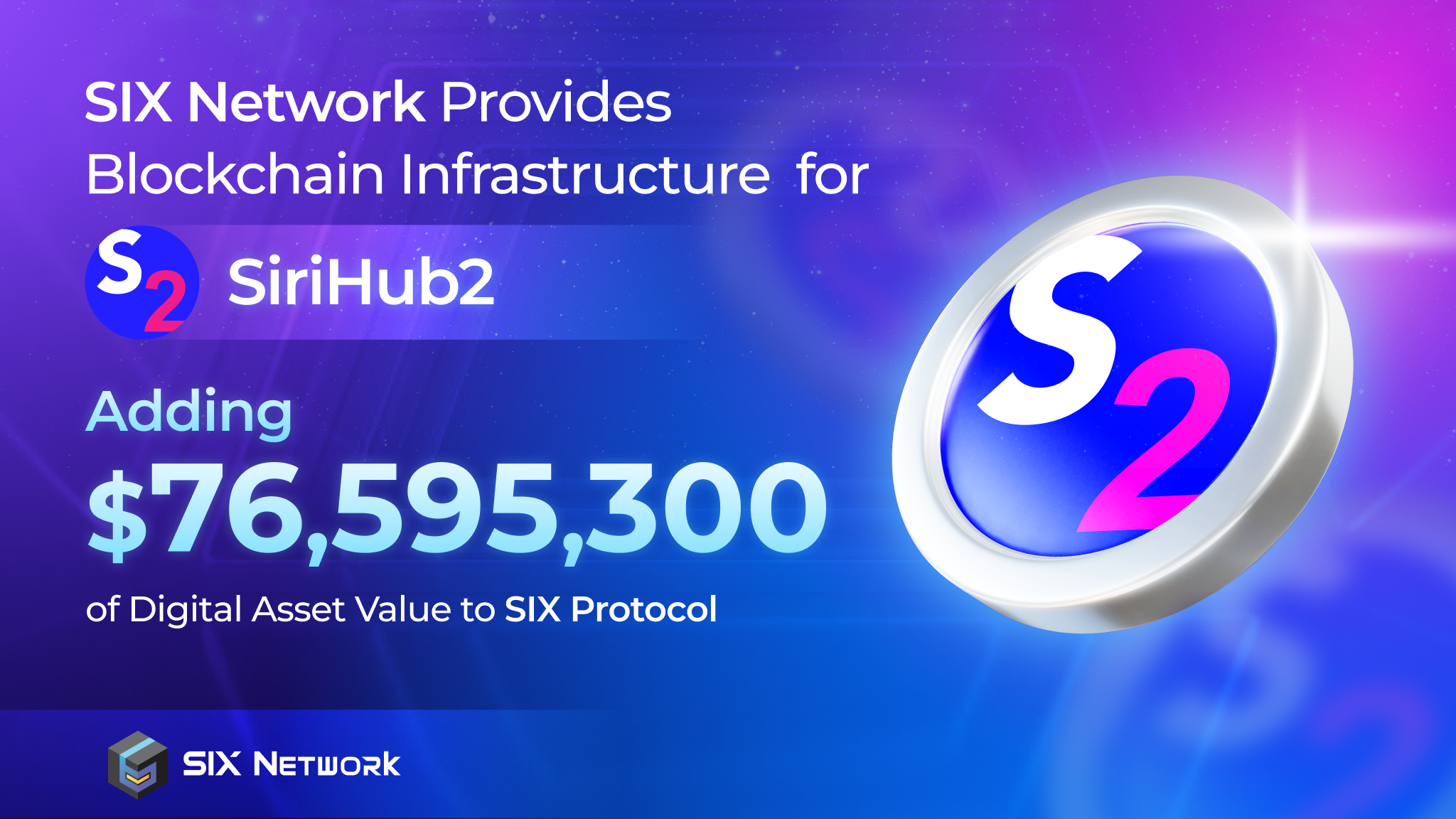
SIX Network Provides Blockchain Infrastructure for SiriHub2, Adding 2.49 Billion THB of Digital Asset Value to SIX Protocol

SIX Network Provides Blockchain Infrastructure for SiriHub2, Adding 2.49 Billion THB of Digital Asset Value to SIX Protocol

SIX Network Provides Blockchain Infrastructure for SiriHub2, Adding 2.49 Billion THB of Digital Asset Value to SIX Protocol

SIX Network is pleased to announce that SiriHub2, a real estate-backed digital investment token, has selected SIX Protocol as the blockchain infrastructure for issuing digital tokens in this project.


The SiriHub2 project has a total fundraising value of $76,595,300 USD, with XSpring Digital serving as the Digital Token Offering System Provider (ICO portal), approved by the Securities and Exchange Commission of Thailand (SEC).


The issuance of this digital token reflects the developer’s confidence in a blockchain system designed to support enterprise-grade use cases, especially in the digital asset market, where real-world assets are used as backing.


SiriHub2: Real Estate-Backed Token Expands Success With $76 Million Fundraising on SIX Protocol

SiriHub2 is an investment token backed by the SIRI Campus office buildings, with an appraised income-based valuation of over $78.0 million and a fundraising target of $76.9 million. The digital token issuer and project owner collaborated with experts from various fields, including legal, valuation, and licensed digital token offering providers.


Token holders are entitled to returns generated from rental income of the SIRI Campus office buildings, located within the T77 community on Sukhumvit 77, a growing district integrating residential, education, and future business hubs. Returns are distributed quarterly at a fixed rate of 6% per year, with principal repayment at project maturity, along with voting rights related to the project.


SiriHub2: One of the Most Anticipated Investment Token Projects in Thailand’s Capital Market

SiriHub2 is a continuation of the highly successful SiriHub Token. This time, the project also received strong investor interest, successfully selling out all tokens, reflecting overwhelming confidence from the market.


With its high-quality real estate asset, SIRI Campus, located in a prime Sukhumvit-area location, the project has drawn wide attention from investors seeking secure assets with predictable returns.


Beyond being a high-potential real estate project, SiriHub2 serves as an important example of how blockchain technology and Real-World Asset Tokenization (RWA) can be integrated seamlessly with real-world assets. It demonstrates that RWA can now be applied in capital markets and deliver new investment products that are transparent, verifiable, and accessible to a broader group of investors.


SIX Protocol: A Blockchain Network Designed for Enterprise-Scale Projects

SIX Protocol is the blockchain network developed by SIX Network, built specifically to support enterprise-level Real World Asset Tokenization projects. It provides the standards and security required for large-scale initiatives across corporations and institutions, while also meeting regulatory compliance requirements.


SiriHub2 uses SIX Protocol as its blockchain network to record and manage all information related to the issuance and transfer of digital tokens. These processes operate through Smart Contracts designed to ensure transparency, verifiability, and immutability, making it suitable for investment tokens backed by real-world assets.


SIX Protocol also utilizes the Proof of Staked Authority (PoSA) mechanism, where validators are selected based on reliability and capability to maintain the network. This enhances system security and stability, which is crucial for managing high-value enterprise assets.


The SiriHub2 offering was conducted through a licensed ICO Portal in accordance with regulatory requirements, with XSpring Digital serving as the Digital Token Offering System Provider. SIX Protocol was selected as the blockchain network for token issuance due to its capabilities that align with the project’s operational needs.


The Success of SiriHub2 Strengthens SIX Protocol as a Blockchain for RWA Tokenization

SiriHub2 is another high-value digital token project utilizing SIX Protocol as its underlying network. This demonstrates that SIX Protocol meets the standards required for large-scale, legally compliant Tokenization projects, an important factor for enterprises seeking reliability in digital asset initiatives.


This success reinforces confidence among corporations and large organizations considering digital asset development, positioning SIX Protocol as a trusted infrastructure choice. Additionally, the increased value of tokenized assets on SIX Protocol further strengthens the ecosystem’s credibility and attracts interest from other developers, creating a positive growth cycle.


Working with major enterprises and supporting high-value Real-World Asset Tokenization is a strategic direction SIX Network continues to pursue. Increased usage on the network directly benefits SIX Token, the native token used for transaction fees and on-chain activities. The more usage generated, the higher the demand for SIX Token, contributing to sustainable long-term ecosystem growth.

Learn More about SIX Network:

Website l Telegram l Twitter l Facebook l Discord l Medium
⎯⎯⎯⎯⎯⎯⎯⎯⎯⎯⎯⎯⎯⎯⎯⎯⎯⎯⎯⎯⎯⎯⎯⎯⎯⎯⎯⎯⎯⎯⎯⎯

Note:

1.This article is intended for informational purposes only. Please conduct your own research before making any investment decisions related to cryptocurrencies

2. Cryptocurrency and digital token involve high risk; investors may lose all investment money and should study information carefully and make investments according to their own risk profile.

Don’t miss out follow us at:

Warisara Thepsiri
Warisara Thepsiri

Experience the magic of Blockchain with SIX Network!

Related Posts

​​SIX Network Announces Partnership with Selanet, AI Agent Infrastructure Developer, to Drive Web3 Ecosystem Growth

SIX Network ประกาศความร่วมมือกับ Selanet ผู้โครงสร้างพื้นฐานสำหรับ AI Agents

SIX Network ประกาศความร่วมมือกับ Selanet ผู้พัฒนา Infrastructure สำหรับ AI Agents เพื่อขับเคลื่อน Web3 Ecosystem   เรามีความยินดีอย่างยิ่งที่ได้ประกาศความร่วมมือกับ Selanet ผู้พัฒนาโครงสร้างพื้นฐานดิจิทัลที่ช่วยให้ AI agents สามารถทำงานบนเว็บไซต์ต่าง ๆ

Read More

นับถอยหลังปรากฏการณ์a Bitcoin Halving กับ SIX Network!

นับถอยหลังปรากฏการณ์a Bitcoin Halving กับ SIX Network!

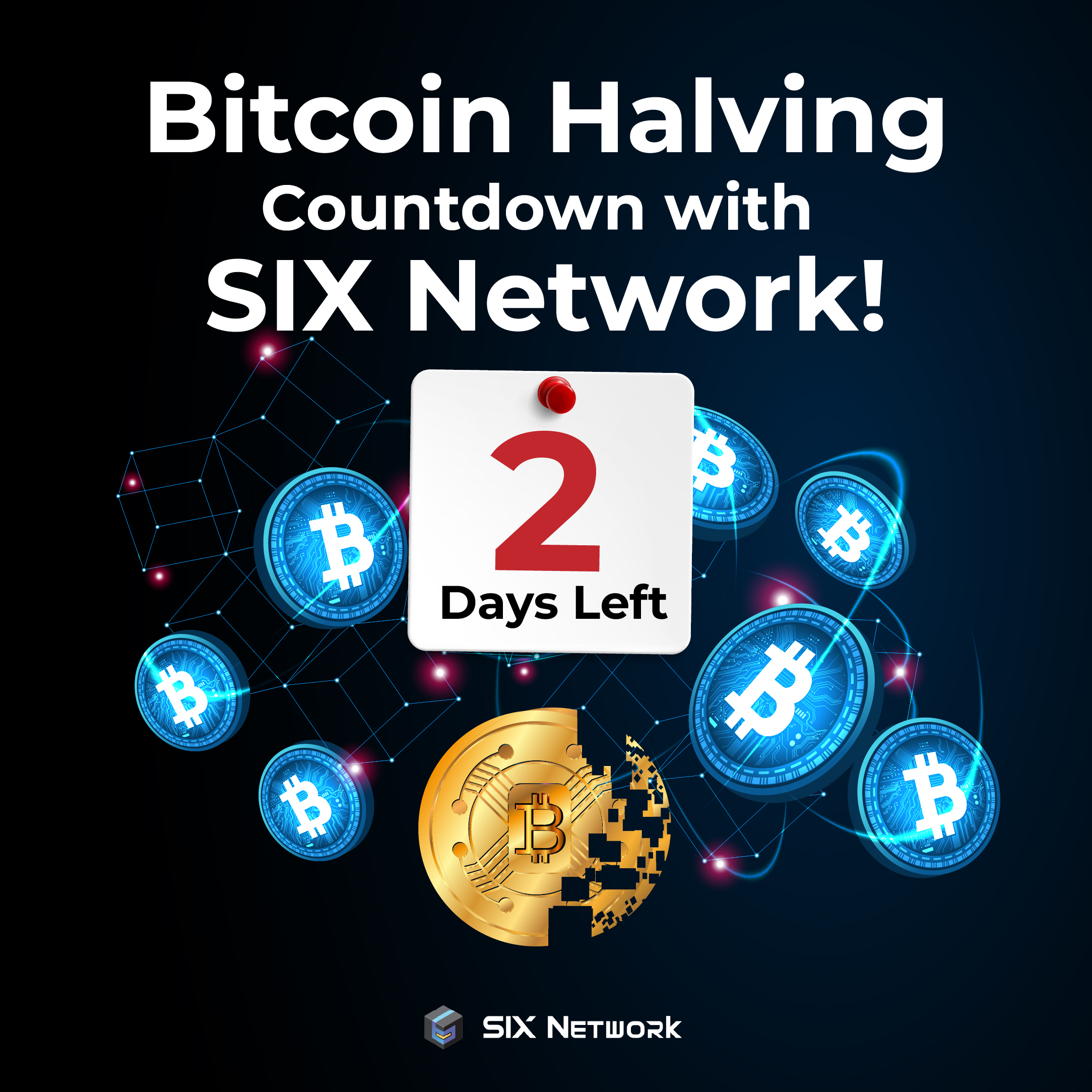
Bitcoin Halving Countdown with SIX Network

พร้อมที่จะฉลองวันแห่ง Bitcoin Halving Day กันแล้วหรือยัง ? 

ร่วมนับถอยหลังกับ SIX Network ในอีก 2 วัน ก่อนจะถึงวันแห่งประวัติศาสตร์ของ

Bitcoin Halving ที่ 4 ปี จะมีแค่ 1 ครั้งเท่านั้น ใกล้ถึงวันที่อาจส่งผลกระทบหลากหลายสิ่งให้วงการคริปโตสะเทือนแล้ว


จะเกิดอะไรขึ้นในเหตุการ์ Bitcoin Halving บ้าง ? SIX Network ได้สรุปมาไว้ให้แล้วที่นี่ 

Bitcoin Halving คืออะไร ?

Bitcoin Halving คือวันที่บิตคอยน์ถูกลดครึ่งหนึ่ง หรือเวลาที่ขุดบล็อกใหม่ในเครือข่ายบิตคอยน์จะลดลงครึ่งหนึ่งทุก ๆ สี่ปี เราจึงเรียกเหตุการณ์นี้ว่า ‘แบ่งครึ่ง’ การแบ่งครึ่งของบิตคอยน์ถูกซ่อนไว้ในระบบโค้ดของบิตคอยน์เพื่อจัดการกับการเงิน และรักษาจำนวนบิตคอยน์ทั้งหมดในระบบให้คงที่ไว้ การแบ่งครึ่งทำให้ส่งผลต่อการขุดบิตคอยน์ใหม่ ซึ่งอาจมีผลต่อราคาของบิตคอยน์และมีผลกระทบต่อตลาดคริปโตรวมถึงนักลงทุนในระยะยาวด้วย


หรือเรียกได้อีกอย่างว่า Bitcoin Halving เป็นเครื่องมือที่ใช้ในการควบคุมปริมาณของบิตคอยน์ โดยการลดรางวัลให้เหลือครึ่งหนึ่ง ซึ่งเหตุการณ์นี้เริ่มครั้งแรกจาก 50 BTC ต่อบล็อกในปี 2012 หลังจากนั้นลดลงมาเหลือ 25 BTC ในปี 2016 และต่อมาลดลงมาเหลือ 12.5 BTC และในปัจจุบันลดลงมาอยู่ที่ 6.25 BTC ผู้สร้างบิตคอยน์อย่าง Satoshi Nakamoto ได้ใช้เครื่องมือนี้อย่างชาญฉลาด เพื่อให้ปริมาณของบิตคอยน์เข้าใกล้กับจำนวนที่กำหนดไว้ทั้งหมด คือ 21 ล้านเหรียญ ซึ่งการแบ่งครึ่งนี้ ทำให้เกิดความตื่นเต้นและน่าสนใจแก่วงการบิตคอยน์อย่างมาก


ผลกระทบต่อวงการคริปโตเคอเรนซี่

ผลของ Bitcoin Halving อาจส่งผลกระทบในอุตสาหกรรมสกุลเงินดิจิทัล และจะมีผลกระทบในด้านต่าง ๆ ในตลาดสินทรัพย์ดิจิทัล ทั้งราคา, มูลค่า และกลุ่มนักลงทุนระยะยาว


สิ่งที่อาจจะเกิดขึ้น ? 

  • ส่งผลต่อความต้องการซื้อและการขาย: การแบ่งครึ่งของบิตคอยน์ ทำให้จำนวนของเหรียญบิตคอยน์ลดลง ซึ่งอาจทำให้มูลค่าเหรียญสูงขึ้น จึงทำให้เกิดความต้องการซื้อที่มีมากกว่าจำนวนเหรียญที่สามารถขายได้

  • ผู้คนทั่วโลกจะตื่นตัวต่อตลาดมากขึ้น: ผู้คนเริ่มมีความตื่นเต้นกับเหตุการณ์ Bitcoin Halving และคาดเดาว่ามันจะส่งผลอย่างไรต่อราคาของบิตคอยน์ จากการตื่นตัวของเหล่านักลงทุนอาจทำให้มีผู้ใช้งานในตลาดซื้อขายสกุลเงินดิจิทัลเพิ่มขึ้น และอาจส่งผลกระทบต่อราคาทั้งก่อนและหลังจากเหตุการณ์นี้

  • รายได้ของนักขุด: การแบ่งครึ่งของบิตคอยน์ ส่งผลให้รายได้ของนักขุดลดน้อยลงสำหรับการสร้างบิตคอยน์ใหม่

  • ความคุ้มค่าของบิตคอยน์ในระยะยาว: การแบ่งครึ่งครั้งนี้แสดงให้เห็นว่าบิตคอยน์อาจลงทุนยากขึ้นเมื่อเวลาผ่านไป ทำให้ดูเหมือนเป็นสิ่งที่ดี ที่จะถือไว้เป็นเวลานาน แม้ว่าราคาจะปรับตัวขึ้นหรือลงอย่างมากในระยะสั้นก็ตาม
Did you know that searches for 'Bitcoin halving' on Google have reached an all-time high ?

รู้หรือไม่ว่า ยอดการค้นหา ‘Bitcoin Halving’
บน Google ในช่วงเวลานี้สูงที่สุดกว่าที่เคยมีมา ? 


ข้อมูลล่าสุดจาก Google Trends พบว่า มีผู้ให้ความสนใจกับเหตุการณ์ Bitcoin Halving เป็นจำนวนมาก ซึ่งมียอดการค้นหา หรือถูกพูดถึงสูงขึ้นอย่างที่ไม่เคยมีมาก่อน ซึ่งตอนนี้คะแนนของคำค้นหา ‘Bitcoin Halving’ ได้ถึง 45 คะแนน และคาดการณ์ว่าจะถึง 100 คะแนนในอีกไม่ช้า หรือภายในสิ้นเดือนนี้ก็เป็นได้ ซึ่งเป็นการทุบสถิติจากปีก่อน ๆ และยังแสดงให้เห็นถึงการเติบโตสำหรับตลาดสกุลเงินดิจิทัล ที่มีผู้คนให้ความสนใจเป็นอย่างมากต่อราคาของ
บิตคอยน์อย่างกว้างขวาง 


ตอนนี้เหตุการณ์ Bitcoin Halving ได้รับความสนใจจากทั่วดลก ซึ่งดูได้จาก Google Trends ว่ามีประเทศอะไรบ้างที่กำลังพูดถึงเหตุการณ์นี้ เช่น ไนจีเรีย, เนเธอร์แลนด์, ซวิตเซอร์แลนด์, และไซปรัส นี่เป็นปรากฏการณ์สำคัญระดับโลกเลยจริง ๆ 


ในขณะเดียวกัน ราคาของบิตคอยน์ก่อนจะถึงวัน Bitcoin Halving มีราคาเริ่มต้นอย่างดีที่ 42,200 ดอลลาร์ และพุ่งสูงถึง 74% แตะยอดสูงสุดที่ 73,600 ดอลลาร์ในวันที่ 13 เมษายน แต่แล้วก็ร่วงลงมาอยู่ที่ราว 61,078 ดอลลาร์ ถึงอย่างนั้นนักลงทุนยังคงมีความหวังในวัน Bitcoin Halving อยู่ (ที่มาจาก : Cointelegraph)


สุดท้ายนี้

เรามาร่วมนับถอยหลังอีก 2 วันเพื่อร่วมฉลองให้กับวัน Bitcoin Halving เหตุการณ์ในประวัติศาสตร์ที่สำคัญต่อวงการคริปโตเคอเรนซี่ ไม่ว่าคุณจะเป็นผู้ถือบิตคอยน์ที่มีประสบการณ์มายาวนาน หรือเป็นมือใหม่ที่สนใจในบิตคอยน์ และแม้แต่คนที่กำลังมองหาโอกาสในการต่อยอดเทคโนโลยีและการเงิน


เตรียมตัวให้พร้อมแล้วมารอคว้าโอกาสทองนี้ไปกับพวกเรา!

ติดตามรายละเอียดเพิ่มเติมเพื่อไม่ให้พลาดข่าวสารของ SIX Network

——————————————–

Follow SIX Network 

https://linktr.ee/Sixnetwork

Join Discord

https://discord.gg/sixnetwork

Don’t miss out follow us at:

Warisara Thepsiri
Warisara Thepsiri

Experience the magic of Blockchain with SIX Network!

Related Posts

​​SIX Network Announces Partnership with Selanet, AI Agent Infrastructure Developer, to Drive Web3 Ecosystem Growth

SIX Network ประกาศความร่วมมือกับ Selanet ผู้โครงสร้างพื้นฐานสำหรับ AI Agents

SIX Network ประกาศความร่วมมือกับ Selanet ผู้พัฒนา Infrastructure สำหรับ AI Agents เพื่อขับเคลื่อน Web3 Ecosystem   เรามีความยินดีอย่างยิ่งที่ได้ประกาศความร่วมมือกับ Selanet ผู้พัฒนาโครงสร้างพื้นฐานดิจิทัลที่ช่วยให้ AI agents สามารถทำงานบนเว็บไซต์ต่าง ๆ

Read More