Understanding Enterprise-Grade Infrastructure for Tokenized Assets with SIX Protocol v4.0
The market for digital assets backed by real-world value continues to expand across sectors such as government bonds, real estate, and commodities. However, market growth does not automatically translate into enterprise readiness.
For organizations, the key question is not what blockchain can do in theory, but what kind of infrastructure is appropriate for mission-critical systems, especially when security, regulatory oversight, and operational stability are involved.
🔎📖 This article explores what enterprise-grade infrastructure means in the context of tokenized assets and how SIX Protocol v4.0 is designed to support these requirements from an architectural perspective.
The Enterprise Challenge
Blockchains designed primarily for general-purpose or public experimentation may not be sufficient for high-value, regulated asset environments.
Real estate tokenization may require structured ownership models, access controls, and traceable approvals across jurisdictions. Commodity trading systems often demand transaction finality within predictable timeframes. Digital securities require auditability, investor protection mechanisms, and alignment with reporting standards.
If the underlying infrastructure cannot support these design considerations, organizations may encounter delayed settlement, unclear access control boundaries, or limited audit transparency. Over time, these constraints affect institutional confidence and long-term scalability.
Enterprise-grade infrastructure must therefore prioritize stability, governance capability, and architectural clarity, not performance alone.
SIX Protocol v4.0 in the Enterprise Context
SIX Protocol v4.0 was developed with enterprise tokenized asset environments in mind, particularly where real-world asset representation intersects with regulatory and operational requirements.
At the architectural level, the protocol supports EVM compatibility. This allows development teams to leverage established Ethereum tooling and standards, reducing dependency on proprietary execution environments. The intent is not simply familiarity, but architectural alignment with a widely adopted ecosystem.
The protocol operates using a Proof of Authority-based validator model, where validator nodes are managed within a structured network. This model supports predictable transaction validation and controlled governance, characteristics often required in institutional environments.
Rather than maximizing decentralization at all costs, the design balances performance, accountability, and operational reliability.
🔗 Learn more about SIX Protocol v4.0
SIX Protocol v4.0 EVM Compatibility Based on the Ethereum Standard
Architecture Designed for Scalable Operations
SIX Protocol v4.0 uses a validator network operated under defined governance structures. This configuration reduces operational uncertainty and enables service-level considerations more aligned with enterprise expectations.
Transactions are grouped, validated, and finalized within short timeframes. For organizations handling asset transfers or financial workflows, reduced settlement latency contributes to improved capital efficiency and operational predictability.
The protocol also supports transaction traceability and structured data recording. Sensitive business or personal data does not need to reside fully on-chain. Instead, organizations can implement hybrid architectures where blockchain functions as an integrity and verification layer.
This architectural flexibility allows enterprises to design systems that align with data protection and internal governance policies.
Performance and Scalability
SIX Protocol is capable of processing transactions at a scale suitable for enterprise-level workloads under controlled network conditions. Transaction finality occurs within short intervals, supporting applications that require operational responsiveness.
Performance characteristics are influenced by network configuration and validator distribution, but the protocol is structured to support growing transaction volumes as enterprise adoption expands.
Fee structures are designed to remain stable and predictable relative to many public networks. For organizations managing large transaction volumes, cost predictability can be as important as raw throughput.
Security and Regulatory Alignment
At the application layer, SIX Protocol supports role-based access control, multi-signature authorization, and configurable transaction workflows. These capabilities allow organizations to embed internal approval processes directly into smart contract logic.
The protocol can integrate with external identity verification systems and supports transaction traceability required for compliance-oriented system design. In certain implementations, controlled transaction reversibility mechanisms can be configured to address specific legal or operational requirements.
However, regulatory compliance ultimately depends on organizational governance, policy design, and operational processes. Infrastructure can enable compliance-oriented architecture, but it does not replace regulatory responsibility.
Real-World Deployment Context
SIX Protocol has been used in digital real estate asset issuance scenarios requiring structured ownership and permission management.
In healthcare-related contexts, blockchain has functioned as a verification layer while sensitive patient data remains stored within secure internal systems. This hybrid model reflects a broader enterprise pattern: blockchain complements, rather than replaces, core systems.
These examples illustrate practical deployment models rather than theoretical capabilities.
Ongoing Development Direction
SIX Network continues to evolve its protocol with attention to privacy enhancements, cross-network interoperability, and scalability improvements.
Future development initiatives focus on strengthening architectural flexibility while maintaining governance clarity. Technologies such as advanced privacy techniques and network optimization mechanisms are under evaluation to support long-term enterprise use cases.
Conclusion
Enterprise-grade infrastructure for tokenized assets requires more than transaction speed. It must support governance structures, controlled access, traceability, and sustainable operational design.
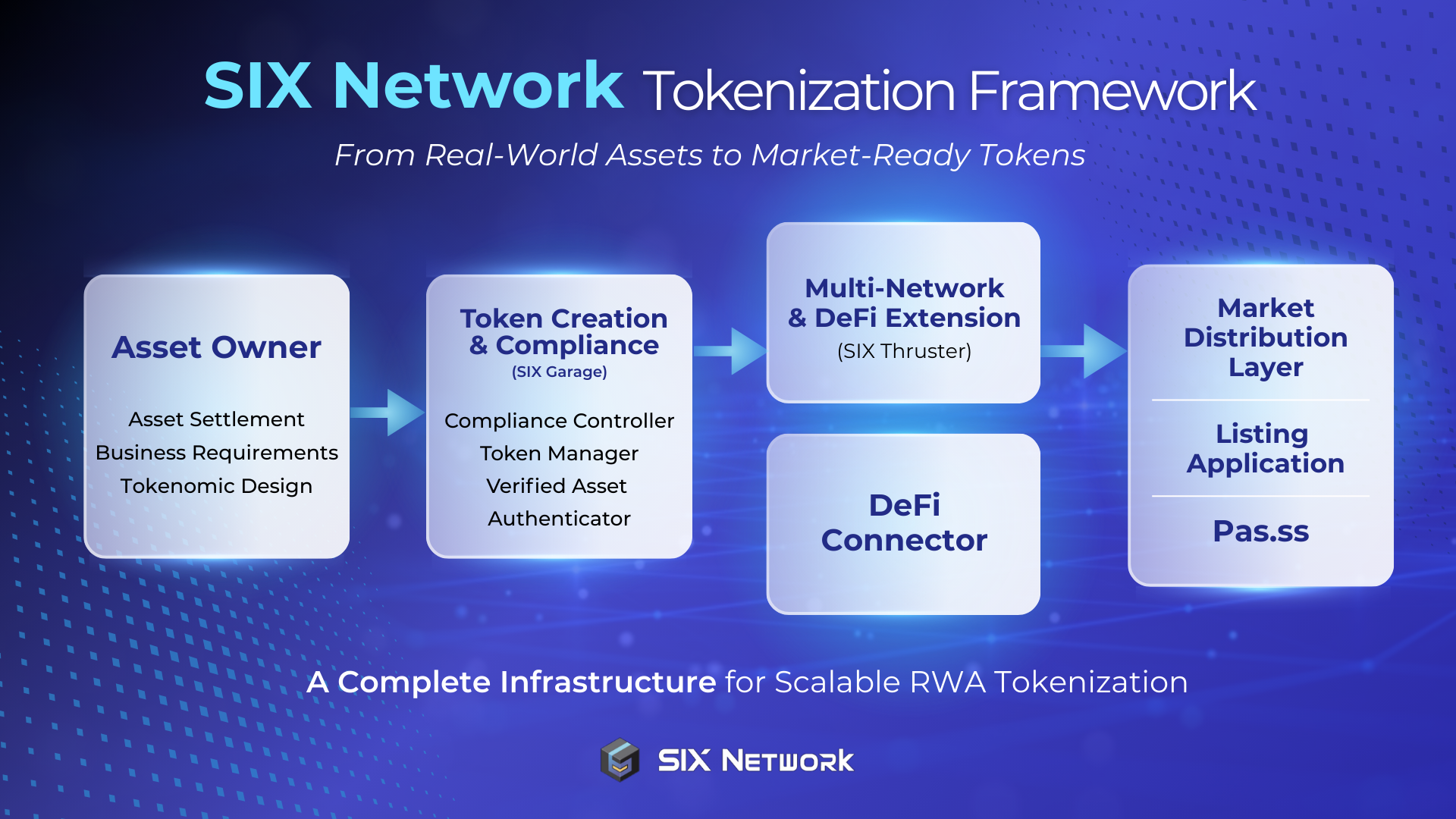
SIX Protocol v4.0 reflects these considerations through standards alignment, a structured validator model, and supporting tools such as SIX Garage and Pas.ss that assist in digital asset lifecycle management.
For organizations evaluating blockchain infrastructure, architectural alignment, governance compatibility, and operational stability should weigh more heavily than performance claims alone.
SIX Network’s approach centers on supporting structured, responsible enterprise adoption rather than positioning blockchain as a standalone solution.
────────────────────────────────────
Learn more about SIX Network
Website l Telegram l Twitter l Facebook l Discord l Medium